
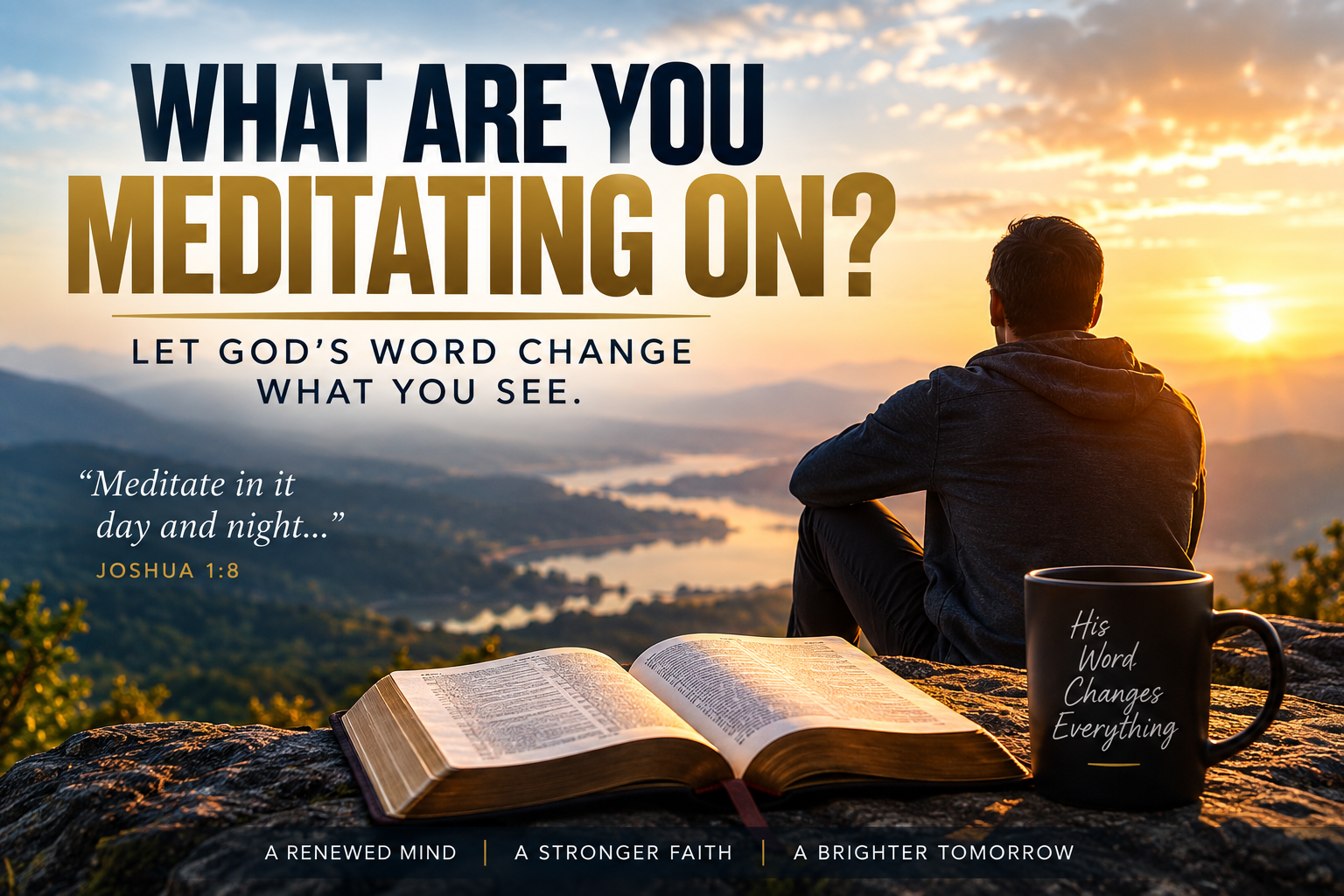
What Are You Meditating On? How God’s Word Changes What You See
When you're going through a difficult season, what occupies your mind?
Think about that for a moment.
When the doctor's report comes, what do you meditate on?
When the bank account isn't where it needs to be, what do you meditate on?
When the business isn't producing, the opportunity hasn't appeared, or the resources aren't there, what keeps playing over and over in your mind?
Most of us naturally meditate on the problem.
We rehearse the conversation.
We replay the diagnosis.
We calculate the shortage.
We imagine what could go wrong.
We go to sleep thinking about it, wake up thinking about it, and spend the day returning to it.
And whether we realize it or not, that's meditation.
Meditation isn't something only deeply spiritual people do. Everybody meditates. The question is:
What are you meditating on?
You Are Already Meditating
Biblical meditation is not emptying your mind. It is deliberately filling your mind with God's truth and turning that truth over and over until it begins changing how you see.
That's exactly what God told Joshua to do.
Joshua was about to assume an enormous assignment. Moses was gone. Joshua now had to lead an entire nation into the land God had promised them.
Imagine the pressure.
This wasn't simply a personal goal. Joshua would face armies, fortified cities, military decisions, leadership problems, and the responsibility of leading millions of people.
God could have given Joshua a thousand leadership principles.
Instead, He told him:
“This Book of the Law shall not depart from your mouth, but you shall meditate in it day and night... For then you will make your way prosperous, and then you will have good success.” — Joshua 1:8
That's worth noticing, especially if you're a leader, entrepreneur, pastor, parent, or anyone carrying a significant assignment.
God connected Joshua's outward success to what was happening inside Joshua first.
Meditate on the Word.
Speak the Word.
Observe the Word.
Act upon the Word.
Then move.
Joshua eventually led Israel in an extraordinary conquest. Joshua 12 records 31 kings defeated under his leadership. The conquered territory was distributed among the tribes, while Reuben, Gad, and half the tribe of Manasseh had received territory east of the Jordan and still joined their brothers in battle.
Joshua had enormous responsibility.
And God prepared his thinking before He expanded his territory.
There's a lesson there:
Before you conquer something externally, God often needs His Word established internally.
Stop Meditating on the Problem
This becomes especially important when you're facing something that looks impossible.
Perhaps it's health.
Perhaps it's finances.
Perhaps it's your business.
Perhaps it's your family.
Perhaps it's an assignment that looks much larger than your present resources.
We often want an immediate miracle.
And there's nothing wrong with believing God for miracles.
But sometimes we're looking so intensely for a dramatic moment that we overlook something God has already placed in our hands:
His Word.
You can begin renewing your mind today.
You can begin meditating today.
You can begin replacing the picture of defeat with the picture God's Word gives you.
Because whatever continually occupies your attention eventually influences what you believe.
If You're Believing for Healing, See Jesus Healing
Suppose you're dealing with a health challenge.
Here's something practical you can do.
Open the Gospel of Mark.
Start reading.
When you reach one of the healing accounts, don't race through it just so you can finish another chapter.
Stop.
Meditate.
Imagine the scene.
Take the leper who approached Jesus in Mark 1.
Where was Jesus standing?
What was happening around Him?
What would it have been like for this man, carrying a disease that separated him from society, to approach Jesus?
What was he thinking?
What did he believe about Jesus?
Then listen to his words:
“If You are willing, You can make me clean.”
Now listen to Jesus:
“I am willing; be cleansed.” — Mark 1:40–41
Don't just read it.
Stay there.
Think about the willingness of Jesus.
Think about His compassion.
Think about what this reveals about His character.
Ask the Holy Spirit to show you what you haven't seen before.
That's meditation.
You're no longer merely reading about healing.
You're allowing the Word to change the picture inside you.
Meditation Is More Than Confession
I believe strongly in speaking God's Word.
Confession matters because what you continually speak also enters your hearing and affects your heart. Romans 10:17 tells us:
“Faith comes by hearing, and hearing by the word of God.”
But meditation takes you deeper.
You're not merely repeating a sentence.
You're considering it.
Seeing it.
Asking questions about it.
Connecting Scripture with Scripture.
Allowing the Holy Spirit to illuminate it.
You're letting God's truth occupy the mental space previously occupied by the problem.
And slowly, sometimes almost without realizing it, your perspective begins changing.
Meditation Must Be Rooted in Identity
There is another piece that's essential.
If you're meditating on God's promises while secretly believing you're unworthy to receive anything from Him, you'll continually fight against yourself.
That's why you must understand your identity in Christ.
Paul wrote:
“I have been crucified with Christ; it is no longer I who live, but Christ lives in me...” — Galatians 2:20
And 2 Corinthians 5:21 tells us:
“For He made Him who knew no sin to be sin for us, that we might become the righteousness of God in Him.”
Your confidence before God isn't based upon your perfect performance.
It's based upon Jesus.
This is grace.
When you're believing God for healing, provision, wisdom, opportunity, or anything else He has promised, you don't approach Him saying:
“I've been good enough, so I deserve this.”
No.
You approach Him through Christ.
Your confidence is in what Jesus accomplished, not what you accomplished.
That changes meditation completely.
Now you're not trying to convince God to bless you.
You're discovering what His grace has already made available in Christ and allowing that truth to reshape your thinking.
Meditate From Grace, Not Fear
That's why I want you to meditate with your mind centered on grace.
Not:
“How can I make God do this?”
But:
“Father, show me what Jesus has already accomplished and how I should respond in faith.”
That moves you away from striving.
You begin recognizing that God isn't your adversary.
He's your Father.
Jesus isn't trying to keep something from you.
The Holy Spirit isn't hiding truth from you.
You're learning to cooperate with God's grace.
There Is Power Working in You
Then consider Ephesians 3:20:
“Now to Him who is able to do exceedingly abundantly above all that we ask or think, according to the power that works in us.”
We love the first half.
Exceedingly abundantly above all we ask or think!
But don't miss the second half:
According to the power that works in us.
There is power at work in the believer through the Holy Spirit.
So here's something you can begin saying:
“Thank You, Father, that Your power is working in me.”
When you need wisdom:
Your power is working in me.
When you're facing sickness:
Your power is working in me.
When resources appear insufficient:
Your power is working in me.
When the assignment looks bigger than your ability:
Your power is working in me.
This isn't magic language.
It isn't a formula.
It's training your mind to agree with Scripture.
Change the Picture Inside
This is where meditation becomes so powerful.
You may have spent months visualizing failure without realizing it.
You saw the business collapsing.
You imagined the doctor's report worsening.
You pictured yourself never recovering.
You rehearsed rejection.
You imagined scarcity.
You were meditating—just on the wrong thing.
Now take that same capacity and submit it to God's Word.
See Christ in you.
Paul calls Christ in us “the hope of glory” (Colossians 1:27).
See yourself strengthened through Christ:
“I can do all things through Christ who strengthens me.” — Philippians 4:13
See yourself positioned in Christ:
God has “raised us up together, and made us sit together in the heavenly places in Christ Jesus.” — Ephesians 2:6
You're changing the internal picture.
And as that picture changes, your expectations begin changing with it.
Trials Don't Have to Control Your Meditation
Jesus never promised we'd live without trouble.
He actually said:
“In the world you will have tribulation; but be of good cheer, I have overcome the world.” — John 16:33
James says something equally surprising:
“Count it all joy when you fall into various trials, knowing that the testing of your faith produces patience.” — James 1:2–3
Why rejoice?
Not because trouble is good.
Not because God necessarily sent the trouble.
But because trouble doesn't have to win.
The trial can become an opportunity for your faith to become stronger and your endurance to mature.
Instead of allowing the circumstance to dictate your meditation, you allow God's Word to interpret the circumstance.
That's a completely different way to live.
Meditation Takes Time
Now let's be practical.
Renewing your mind in a particular area can take time.
If you've spent twenty years believing one thing, don't become discouraged because reading three verses didn't completely change your thinking overnight.
Keep going.
Joshua was instructed to meditate day and night.
Why?
Because repetition matters.
Seeds grow.
Truth takes root.
Your thinking changes.
Your confidence develops.
Faith becomes established.
Sometimes something clicks in minutes. Other areas require days, weeks, months, or a sustained season of renewing your mind.
Don't turn that into condemnation.
Just keep planting.
Don't Make Meditation a Formula
This is important.
Meditating on Scripture isn't a technique for controlling God.
It's not:
“If I meditate for exactly thirty minutes every morning, God owes me a miracle.”
That's religion.
Biblical meditation is relational.
You're spending time with God's Word because the Word reveals Jesus.
You're allowing the Holy Spirit to illuminate truth.
You're learning the Father's character.
You're discovering who you are in Christ.
You're allowing truth to replace lies.
And as that happens, faith rises naturally.
The goal isn't becoming obsessed with the manifestation.
The goal is becoming occupied with Jesus.
Hebrews tells us to look unto Jesus, “the author and finisher of our faith” (Hebrews 12:2).
That's ultimately where meditation should take you.
What Are You Meditating On Today?
So let's return to the original question.
What are you meditating on?
The sickness?
The shortage?
The business problem?
The person who hurt you?
The opportunity you missed?
The thing you're afraid might happen?
Or are you meditating on God's Word?
You don't have to pretend the circumstance doesn't exist.
You simply don't have to give it the majority of your mental attention.
Find Scriptures that speak to the area you're facing.
Read them.
Speak them.
Ask questions.
Picture the biblical scenes.
Look at Jesus.
Ask the Holy Spirit for understanding.
Remind yourself who you are in Christ.
And keep doing it.
You're planting something.
You're renewing something.
You're developing something.
And eventually, you may look up and realize something remarkable:
The circumstance that once consumed your thoughts no longer controls you.
Perhaps the situation has changed.
Perhaps you're still walking through the process.
But you have changed.
Fear isn't dominating you anymore.
Faith has risen.
Peace has returned.
Wisdom is coming.
You're recognizing possibilities you couldn't see before.
And you're discovering that the Word you've been meditating on has been doing something inside you all along.
So today, instead of continually rehearsing the problem, make a different decision:
Meditate on the Word.
Let the Word reveal Jesus.
Let Jesus reshape your expectations.
Let the Holy Spirit illuminate the truth.
And keep your heart anchored in grace.
Because what you continually put before your eyes and allow into your heart will eventually shape what you believe.
And what you truly believe will eventually change the way you live.
Leave a Comment